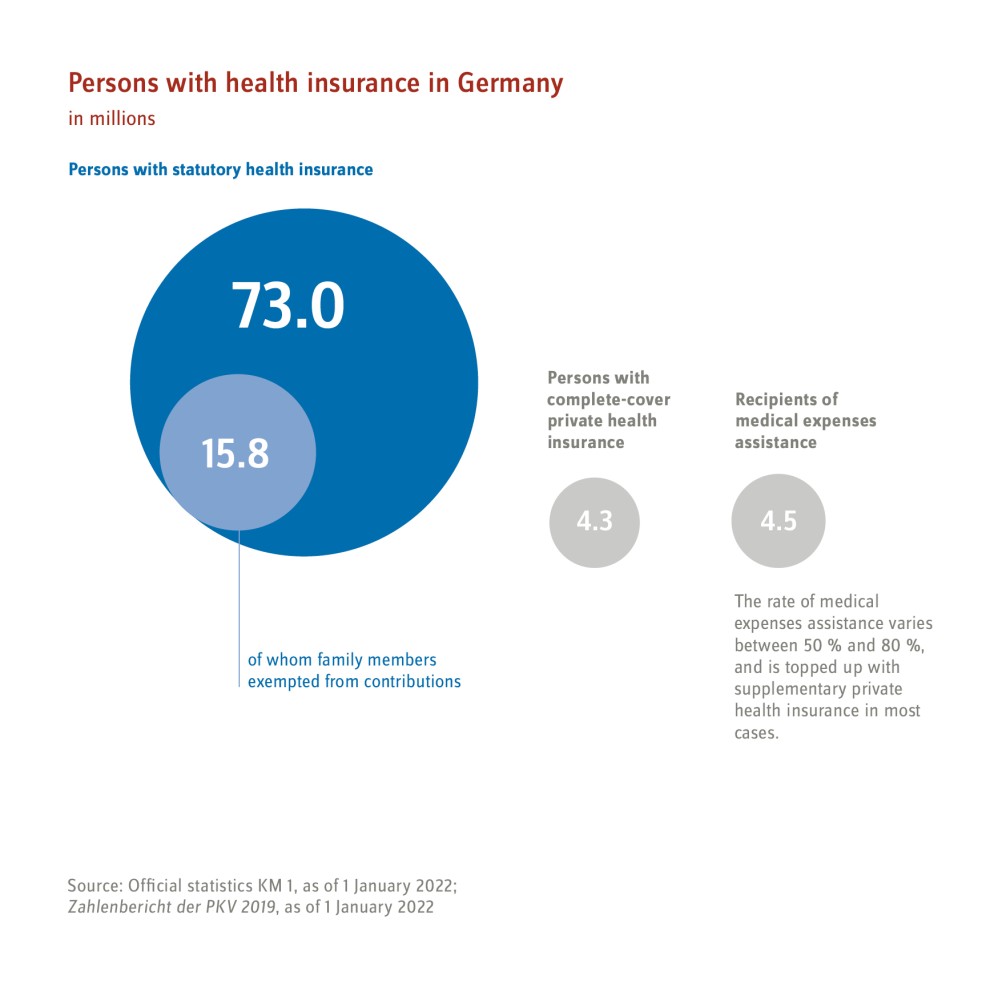
Roughly 90 percent of the population in Germany are members of statutory health insurance and are entitled to receive benefits to maintain and restore their health or to improve their state of health.
Statutory health insurance is financed by statutory health insurance funds which, being public-law corporations, are financially and organisationally independent. They carry out the tasks assigned to them by the State on their own responsibility.
The fundamental structural principles of statutory health insurance are the solidarity principle and the principle of benefits in kind. The solidarity principle guarantees that each insured person receives the benefits from statutory health insurance which are medically necessary, regardless of their income or of the amount of premiums which they have paid and of their morbidity risks. The principle of benefits in kind ensures benefits without up-front payments on the part of the insured.
Statutory health insurance benefits are largely funded through contributions which are paid by employers and employees. The Health Fund and a uniform contribution rate for all insured persons were introduced as per 1 January 2009. What is also new since this date is the tool of supplementary premiums for individual insurance funds.